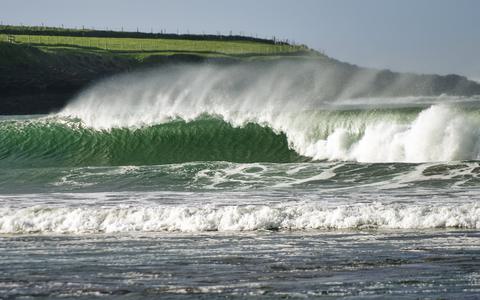
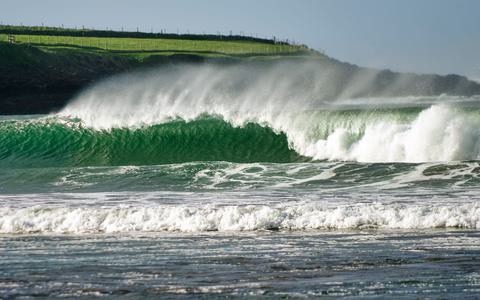
Best time to surf in Ireland.

The best time to surf in Ireland is April, when both breaks we score are in season. The waves run biggest November to February (typical faces 5 to 7 ft) and smallest April to September (3 to 4 ft).

The 2 Ireland breaks we score against years of hindcast, month by month: what makes each one work, when it is in season, the water, and how to get there. Each break's page has its live forecast and the trip from your airport.

This week

  1. Bundoran (The Peak)Fri Nov 204 ft7/10
  2. LahinchFri Nov 207-8 ft6/10

Updated

Get a phone alert when a break in Ireland fires.

Get the iPhone app
QR code for BarrelFare on the App StoreOn an iPhone? Scan for the app.

Best time to surf in Ireland, month by month

How many of the 2 breaks are in season each month, and the median typical wave, share of surfable days and water temperature across all of them.

MonthIn seasonTypical waveSurfable daysWaterWear
Jan 1 of 2 6 ft 64% 9 C / 47 F hooded 5/4
Feb 1 of 2 7 ft 54% 8 C / 47 F hooded 5/4
Mar 1 of 2 5 ft 82% 9 C / 48 F hooded 5/4
Apr 2 of 2 4 ft 65% 10 C / 50 F hooded 5/4
May 1 of 2 3 ft 69% 14 C / 56 F 4/3 + boots
Jun 0 of 2 3 ft 46% 15 C / 60 F 4/3
Jul 0 of 2 3 ft 55% 17 C / 62 F 4/3
Aug 0 of 2 3 ft 54% 17 C / 62 F 4/3
Sep 0 of 2 4 ft 65% 16 C / 60 F 4/3
Oct 1 of 2 4 ft 63% 14 C / 57 F 4/3 + boots
Nov 1 of 2 5 ft 68% 12 C / 53 F hooded 5/4
Dec 1 of 2 6 ft 56% 10 C / 50 F hooded 5/4

Each break in Ireland, month by month

BreakJFMAMJJASOND
Bundoran (The Peak)
Lahinch

BestGoodShoulderOff

Bundoran (The Peak)

Atlantic reef; powerful and shallow.

The wave. The Peak is an A-frame reef on the outer edge of the rock shelf south of Bundoran's main beach. The left is the longer, faster wall with pitching sections, and the right is shorter and bowls into the rip. Bundoran hosted the European Surfing Championships in 1985 and 2011.

When it works. West swell is the best match, and southeast wind blows offshore. Low to mid tide is best, and a rising tide is often better. West and southwest wind is the main problem. The reef can work at any time of year.

Watch out for. The reef is flat rock, with urchins and rips, and water quality drops after rain. Paddle out through the deep channel by the right. The lineup gets busy whenever it works, and the locals all know each other, so surf with respect.

Who it suits. The Peak suits intermediate surfers, and the low-tide slab at Inside Left is for stronger surfers. Beginners learn at Tullan Strand or on the sandy part of Main Beach.

Nearby. Tullan Strand, about 1 km north, turns west to northwest swell into shifting sandbanks, works on all tides, and has shelter below the cliffs at its south end. Rossnowlagh, about 9 km north, has sandbanks along the bay that get better as the tide pushes in, and it is good for beginners in summer.

The wave
A hollow reef break.
Best months
Oct–Dec
Typical face
4–7 ft in season
Surfable days
74% in season
Water in season
12 C / 53 F, hooded 5/4
Sweet spot
7 ft faces
Tide
Best on a mid tide
Nearest airport
NOC
Getting there
88.4 km by road from NOC, about 1 hr 24 min.

Flying in with a board. Airlines we have seen into NOC: Aer Lingus, Ryanair.

Forecast and the trip from your airport

Lahinch

Ireland's surf-town beach; friendly Liscannor Bay peaks with the Cliffs of Moher up the road.

The wave. Lahinch is a sandy beach break in front of the town in County Clare, with A-frame peaks that break left and right. When the sandbars line up, the bank has good shape and peels both ways. The beach faces west-southwest, and a long reef left breaks at its south end.

When it works. West swell is the best match, and east wind blows offshore. The beach works on all tides, and a rising tide is often better. Spring is often the best season, but the bay can work at any time of year.

Watch out for. Rips and rocks are the main hazards, and a rip on the left side of the peaks can pull you out. High tide covers the beach. The lineup is often crowded when it works.

Who it suits. The beach suits beginners and intermediates, and learners use the gentler peaks to the north. The nearby reefs are not for beginners.

Nearby. Lahinch Left, at the south end of the beach, is a long reef left over a rock ledge with rides of 300 m or more, and it is shallow at low tide. Cornish Reef, about 3 km away, is a left reef that works best in east wind and holds waves up to 10 feet.

The wave
A mellow beach break.
Best months
Apr
Typical face
4 ft in season
Surfable days
62% in season
Water in season
11 C / 51 F, hooded 5/4
Sweet spot
4 ft faces
Tide
Works on any tide
Nearest airport
SNN
Getting there
53.2 km by road from SNN, about 50 min.

Flying in with a board. Airlines we have seen into SNN: United Airlines, Ryanair, Aer Lingus.

Forecast and the trip from your airport

Surfing in Ireland: quick answers

When is the best time to surf in Ireland?

The best time to surf in Ireland is April, when both breaks we score are in season. The waves run biggest November to February (typical faces 5 to 7 ft) and smallest April to September (3 to 4 ft).

When are the waves biggest in Ireland?

The waves run biggest November to February (typical faces 5 to 7 ft) and smallest April to September (3 to 4 ft).

When is the off season for surf in Ireland?

June to September: none of the 2 breaks we score is in season then.

What wetsuit do I need to surf in Ireland?

It depends on the month. The water runs from 8 C / 47 F in February (hooded 5/4) to 17 C / 62 F in August (4/3), the median across the breaks.

Which airport do I fly into to surf in Ireland?

It depends on the break: each one we score has a different nearest airport (NOC, SNN). Each break's page has the ground leg from the airport.

Season figures come from years of hindcast, not a forecast (how we score a month). All countries: the full spots index. By month instead: where to surf, January through December.