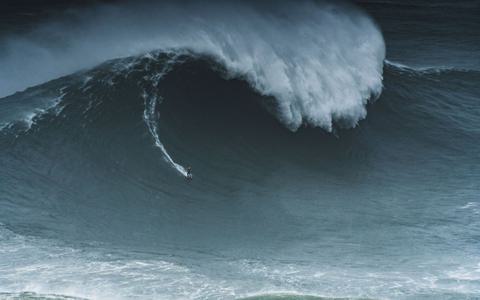
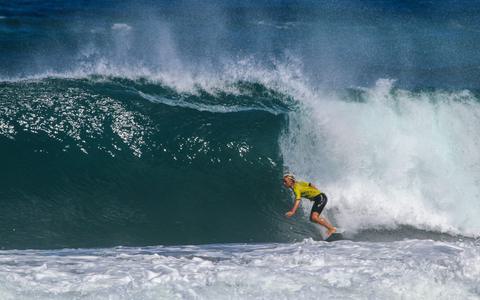
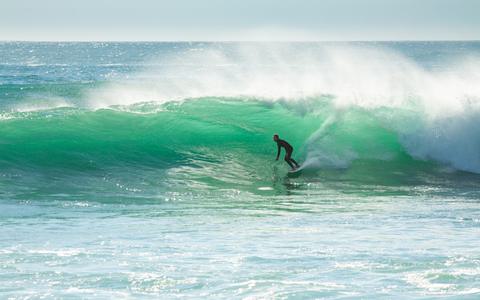
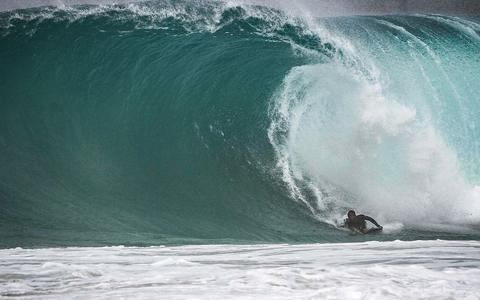
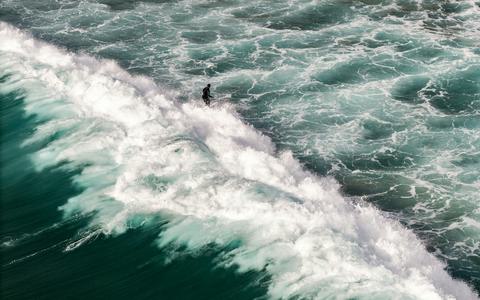
Canyon-amplified big wave.
The wave. Praia do Norte breaks left and right below the Nazaré headland, about two-thirds of a mile from the canyon head. Depth drops from about 50 to 65 feet at the takeoff to about 410 feet at the canyon head. That sudden step bends northwest swell into crossing lines that stack into giant wedges.
When it works. Big northwest groundswells from North Atlantic winter storms drive the giant days. East wind blows offshore. Swell angle and storm position decide the size more than the tide does.
Watch out for. Giant days are tow-in territory, with jet ski teams putting surfers onto the waves. Brazilian big-wave surfer Márcio Freire died here in January 2023, the first surfer death at Praia do Norte. In October 2020, thousands of spectators crowded the cliffs, and authorities closed the lighthouse road.
Who it suits. The big days are for professional tow teams only. Strong paddle surfers ride it on overhead days, but paddling stops working as the swell builds. Everyone else watches from the fort at the lighthouse, Forte de São Miguel Arcanjo.
Nearby. Peniche, to the south, has Supertubos, a hollow, shallow sand-bottom break for advanced surfers, and Baleal for beginners. São Pedro de Moel, to the north, has A-frame peaks over sand and rock.
- The wave
- A hollow beach break.
- Best months
- Jan–Feb
- Typical face
- 12–14 ft in season
- Surfable days
- 76% in season
- Water in season
- 15 C / 59 F, 4/3
- Sweet spot
- 34 ft faces
- Tide
- Best on a low tide
- Nearest airport
- LIS
- Getting there
- 120 km by road from LIS, about 1 hr 27 min.
Flying in with a board. Airlines we have seen into LIS: TAP Air Portugal, Air Canada, United Airlines, Ryanair, Aer Lingus, American Airlines.
Forecast and the trip from your airport
Black-sand QS venue on São Miguel's north shore; the Azores' most consistent beach break.
The wave. Praia de Santa Bárbara is a black-sand beach about a kilometer long near Ribeira Grande, on the north coast of São Miguel. Left and right peaks break over sand with some rocks, and the waves are powerful and often hollow. The beach hosts WSL Qualifying Series events.
When it works. North to northwest swell is the best match, and south wind blows offshore. It works on all tides. Winter brings the heaviest north swells, and guides rate fall and spring as often best, because winter can bring too much swell.
Watch out for. Rips and undertow run along the beach. Winter north swells bring heavy sets and fast, wedgy drops. The lineup draws moderate crowds when it is good, so respect the locals.
Who it suits. On small, clean days the peaks suit all levels, and it is one of the main learner beaches on the island. The heavy winter days and the best barrels are for experienced surfers.
Nearby. Rabo de Peixe, a short way west, breaks over shallow reef, likes north-northwest swell and south wind, and is rarely crowded. Praia do Monte Verde, also on the north coast, has A-frames over sandbanks, and on big days of 8 feet and up it is for experts only.
- The wave
- A punchy beach break.
- Best months
- Nov–Jan
- Typical face
- 4 ft in season
- Surfable days
- 59% in season
- Water in season
- 18 C / 65 F, 3/2
- Sweet spot
- 4 ft faces
- Tide
- Best on a mid tide
- Nearest airport
- PDL
- Getting there
- 22.1 km by road from PDL, about 21 min.
Flying in with a board. Airlines we have seen into PDL: TAP Air Portugal, United Airlines, Transavia (France & Netherlands).
Forecast and the trip from your airport
Ericeira's contest right point over rock; heart of Europe's first World Surfing Reserve.
The wave. Ribeira d'Ilhas is a long right-hand point over rock reef at the north edge of Ericeira, with whitewater on the inside and lined-up walls on the outside. Rides run 150 to 300 meters. It hosted Portugal's first national surfing competition in 1977 and still hosts national and international contests.
When it works. West-northwest swell is the best match, and winds from the east and southeast blow offshore. Winter is the best season, though it can work at any time of the year.
Watch out for. Rocks sit in the lineup, so take care on entry and over the reef. The easy access and the wave's name make it crowded when the surf is up, so respect the locals.
Who it suits. On small days, beginners can ride the inside whitewater. The outside walls suit intermediates and up, and the biggest winter swells call for experience.
Nearby. Coxos, north of town, is a shallow reef right with big barrels, urchins on the reef and a territorial local crew, so it is for experts only. São Lourenço, at the north end of the World Surfing Reserve, is a reef right with rides of more than 150 meters, best on the lower tides.
- The wave
- A punchy point break.
- Best months
- Dec–Feb
- Typical face
- 7–8 ft in season
- Surfable days
- 77% in season
- Water in season
- 16 C / 60 F, 4/3
- Sweet spot
- 5 ft faces
- Tide
- Works on any tide
- Nearest airport
- LIS
- Getting there
- 48.0 km by road from LIS, about 44 min.
Flying in with a board. Airlines we have seen into LIS: TAP Air Portugal, Air Canada, United Airlines, Ryanair, Aer Lingus, American Airlines.
Forecast and the trip from your airport
Hollow beachbreak; WSL stop.
The wave. Supertubos is a beach break over shifting sandbars on Peniche's south-facing bay, with hollow lefts and rights. Waves drag back off the banks into steep, fast peaks, and the lefts often work better than the rights. It is the regular venue of the WSL Championship Tour event in Peniche.
When it works. West to southwest swell is the best match, and northeast to east wind blows offshore. Winter swells make it overhead and powerful, and summer is mostly flat.
Watch out for. Waves break hard and fast in shallow water, many peaks close out, and broken boards are common. Rip currents are strong. Crowds can be extreme on prime swells and during contests, sometimes enough to be dangerous.
Who it suits. It suits intermediate and advanced surfers, and the big days are for experts only. Beginners should head to Baleal instead.
Nearby. Molhe Leste, by the harbour breakwall, is a right that comes alive on the biggest northwest swells, which bounce off the wall into barrels. Baleal is sheltered from the biggest swells and winds, and its beaches are the main learner zone, busy with surf schools.
- The wave
- A hollow beach break.
- Best months
- Dec–Feb
- Typical face
- 7–8 ft in season
- Surfable days
- 72% in season
- Water in season
- 15 C / 60 F, 4/3
- Sweet spot
- 7 ft faces
- Tide
- Best on a mid tide
- Nearest airport
- LIS
- Getting there
- 95.1 km by road from LIS, about 1 hr 9 min.
Flying in with a board. Airlines we have seen into LIS: TAP Air Portugal, Air Canada, United Airlines, Ryanair, Aer Lingus, American Airlines.
Forecast and the trip from your airport
Consistent west-facing beach under the Sagres fortress; a swell magnet when the Algarve is flat.
The wave. Tonel is a beach break under the high cliffs on the west side of Sagres, beside the Sagres Fortress. It takes the full force of the Atlantic, and peaks break left and right over sand. A big rock stack stands in the bay, and on the biggest days an A-frame in front of it throws barreling lefts and wedgy rights.
When it works. West to west-northwest swell is the best match, and northeast to east wind blows offshore. Tide matters little here. Winter is the best season, and the high cliffs give some shelter from the summer wind.
Watch out for. Rips are strong, and currents swirl around the rocks as the tide drops. Many small rocks sit under the water near the shore, most of all at the western end. Rock can fall from the cliffs, so keep away from their base.
Who it suits. Small summer days suit beginners, and surf schools use the beach. The big autumn and winter waves are for advanced surfers only. Many learners go to the more protected beaches at Mareta or Martinhal instead.
Nearby. Mareta, on the south-facing side of town, is sheltered from west and northwest wind, so its waves are tamer. Beliche, a short drive northwest, works on big northwest or huge south swells, and its main wave is on the reef at the west end of the bay.
- The wave
- A punchy beach break.
- Best months
- Dec–Feb
- Typical face
- 6–7 ft in season
- Surfable days
- 75% in season
- Water in season
- 16 C / 61 F, 4/3
- Sweet spot
- 4 ft faces
- Tide
- Works on any tide
- Nearest airport
- FAO
- Getting there
- 121 km by road from FAO, about 1 hr 44 min.
Flying in with a board. Airlines we have seen into FAO: Ryanair, TAP Air Portugal, easyJet, United Airlines, Aer Lingus, Icelandair.
Forecast and the trip from your airport