One of the longest left points on earth.
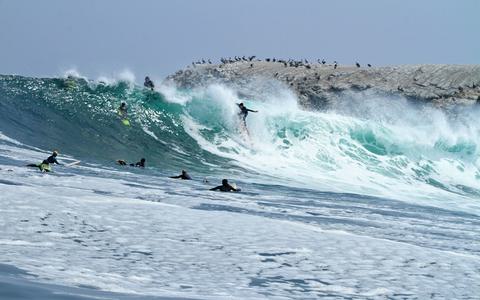
The wave. Chicama is a left-hand point that peels along a rocky cape at Puerto Malabrigo on Peru's north coast. NASA puts the distance from Malpaso to the pier at nearly 4 kilometers, but the sections rarely link, so surfers need several waves to cover it. In 2013 Peru protected the area from development, and Chicama was the first wave in its Protected Waves Registry.
When it works. Long-period groundswell from the southwest to south-southwest is the best match, and east-northeast wind blows offshore. Light wind gives the cleanest walls. Northwest swells do not angle well into the headland.
Watch out for. The point breaks over rock, so take care on entry and exit. The lineup is getting busier, and crowds grow when the big swells arrive. Boats wait at the end of the ride to carry surfers back to the takeoff, or you paddle back.
Who it suits. Forgiving shoulders make it a good fit for intermediates and up, and small days can suit beginners. Malpaso, the farthest-out section, is the heaviest and most demanding.
Nearby. Pacasmayo, just to the north, is a swell magnet with a fast, hollow left. Huanchaco, farther south, is a left point with rides of about 600 meters, and its pier cuts off the last section.
- The wave
- A mellow point break.
- Best months
- All year
- Typical face
- 4–6 ft in season
- Surfable days
- 100% in season
- Water in season
- 18 C / 65 F, 3/2
- Sweet spot
- 8 ft faces
- Tide
- Works on any tide
- Nearest airport
- TRU
- Getting there
- 72.8 km by road from TRU, about 1 hr 17 min.
Flying in with a board. Airlines we have seen into TRU: LATAM Airlines.
Forecast and the trip from your airport
Consistent SW; long lefts.
The wave. The main point at Lobitos is a left that breaks at the southwest end of the town's main beach, on Peru's far north coast. The takeoff sucks up fast over rocks, then the wave runs into long walls, and on good days rides reach about 200 meters. Oil platforms stand on the horizon.
When it works. It takes swell from south to northwest. South swells in the southern winter hook into the point and make long lefts, and some guides rate northwest swell as the best match. East to southeast wind blows offshore, and early mornings are usually cleanest.
Watch out for. Rocks sit in the lineup and under the takeoff, so take care on entry and exit. The sand on the bottom moves a lot, and the wave changes with it.
Who it suits. The main point suits intermediates, who can sit on the shoulder for the softer lines and work on their cutbacks. Advanced surfers look to El Hueco and Baterias when the swell fills in.
Nearby. El Hueco, on the outside of the main point, is a reef left with hollow waves, a critical takeoff and shallow rock, for experienced surfers only. Baterias, a walk south around the headland, is a left that is more exposed and heavier than the main point.
- The wave
- A punchy point break.
- Best months
- Feb–May
- Typical face
- 4–6 ft in season
- Surfable days
- 99% in season
- Water in season
- 24 C / 76 F, boardshorts
- Sweet spot
- 7 ft faces
- Tide
- Best on a mid tide
- Nearest airport
- PIU
- Getting there
- 139 km by road from PIU, about 1 hr 44 min.
Flying in with a board. Airlines we have seen into PIU: LATAM Airlines.
Forecast and the trip from your airport
Warm-water left point in front of town; long walls on S/SW winter groundswell, a second season on Nov-Mar NW swell, desert-morning glass.
The wave. Máncora is a left-hand point on Peru's north coast that breaks over flat rocks, cobbles and sand. Rides usually run 50 to 150 m and reach about 300 m on good days. A fast first section suits snaps, and a slower section farther down suits big cutbacks. Guides call it a small version of Chicama.
When it works. Swell from the southwest to the northwest wraps into the point, and east to southeast wind blows offshore. Early mornings are often glassy. It works on all tides. The water stays warm for most of the year, with a 3/2 wetsuit at most in late winter.
Watch out for. The bottom is rock and cobble, so take care on entry and exit. The point gets crowded when it works, and weekends and holidays are the busiest times. Guides report some localism, so respect the lineup.
Who it suits. On most days it suits beginners to intermediates. Learners also use the smaller peaks along the main beach, and Pocitas, just south of town, has small, mellow waves.
Nearby. Punta Ballenas, about 4 km south, is a fickle left over reef that needs size, and big swells there make slabby barrels for advanced surfers only. Los Organos, about 12 km away, is a left reef break that likes northwest swell and east-southeast wind, with rocks to watch for.
- The wave
- A mellow point break.
- Best months
- Mar–Oct
- Typical face
- 4–5 ft in season
- Surfable days
- 100% in season
- Water in season
- 22 C / 72 F, spring suit
- Sweet spot
- 4 ft faces
- Tide
- Works on any tide
- Nearest airport
- TBP
- Getting there
- 114 km by road from TBP, about 1 hr 33 min.
Flying in with a board. Airlines we have seen into TBP: LATAM Airlines.
Forecast and the trip from your airport