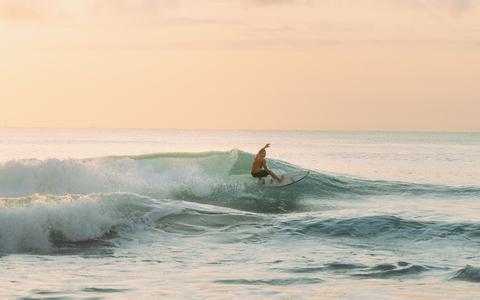
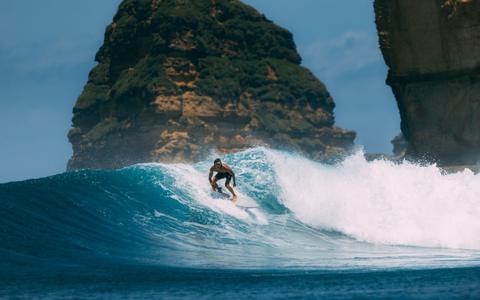
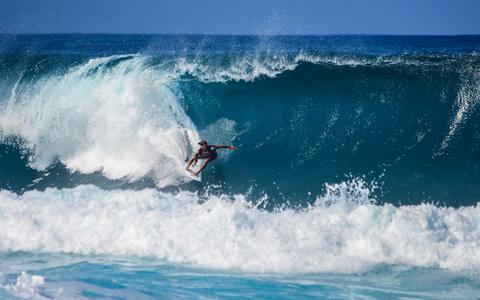
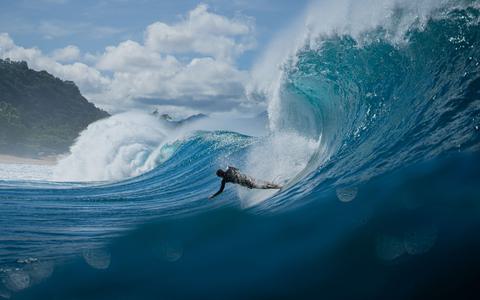
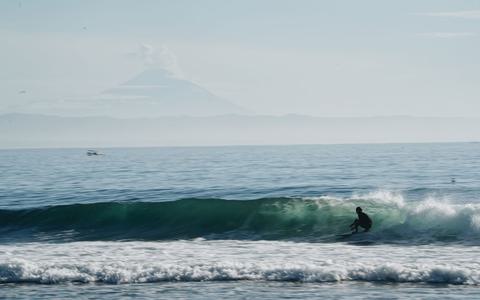
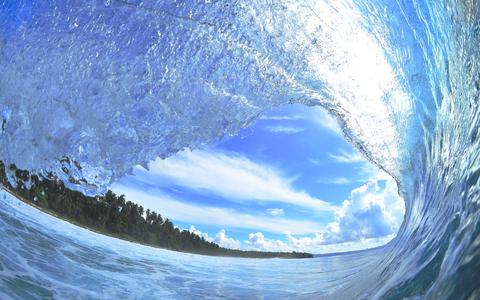
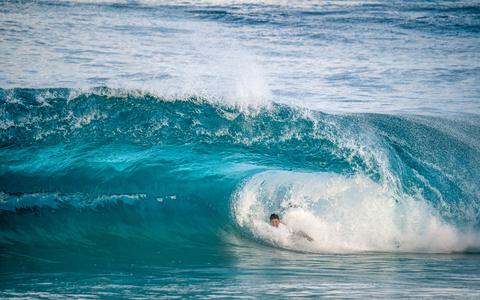
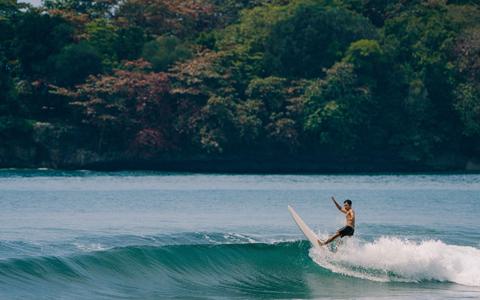
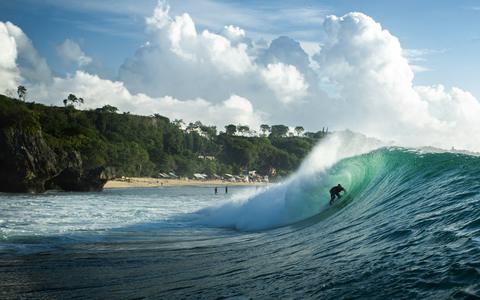
Canggu's mellow longboard reef peelers by the temple; works year-round, best dry-season mornings.
The wave. Batu Bolong is the main beginner wave in Canggu, on Bali's southwest coast. Soft, slow waves break left and right in long lines over a mix of sand, stone and reef. The rights run longer and carry surfers toward the beach, and the lefts peel toward the channel and fade in deeper water.
When it works. Southwest swell is the best match, and northeast wind blows offshore. Mornings are cleanest, because the southeast trades turn sideshore from about 10 AM. The dry season brings the most reliable swell, and the wet season brings more onshore wind.
Watch out for. The lineup is crowded most days, with surf schools and longboards packed close together, so collisions are a real risk. A heavy shore pound can form, and it is usually smaller at the south end. Water quality can drop after heavy rain.
Who it suits. Small, slow days suit beginners, longboarders and mid-length riders. Bigger swells draw more experienced surfers. Shortboarders who want more punch often go to Berawa instead.
Nearby. Berawa, a short way along the coast, has an A-frame peak over shifting sand with shallow reef on both sides, and The Ledge there is a fast right over shallow reef that works at low tide. Echo Beach, to the north, has a fast left over shallow reef that is not for beginners.
- The wave
- A mellow reef break.
- Best months
- Apr–Oct
- Typical face
- 4–5 ft in season
- Surfable days
- 99% in season
- Water in season
- 29 C / 83 F, boardshorts
- Sweet spot
- 4 ft faces
- Tide
- Best on a mid-high tide
- Nearest airport
- DPS
- Getting there
- 18.9 km by road from DPS, about 26 min.
Flying in with a board. Airlines we have seen into DPS: Jetstar, Qatar Airways, Emirates, Qantas, Indonesia AirAsia, Lion Air.
Forecast and the trip from your airport
Long, hollow, dredging left.
The wave. Desert Point, also called Bangko-Bangko, is a long, hollow left over shallow coral reef at the southwest tip of Lombok. On the best days a ride can last 20 to 30 seconds. California surfer Bill Heick and his friends found it in the early 1980s, kept it quiet for years, and named it for the dry, harsh land behind it.
When it works. It needs a big south to southwest groundswell, and it is inconsistent, so you may wait days for it to break. Winds from the east-northeast to southeast blow offshore. Long-period groundswell is the most reliable source.
Watch out for. The inside section closes on shallow, jagged reef, and a fall there is serious. Strong rips run along the reef, and the lineup is often crowded when it breaks. The last couple of kilometres to the point are a dirt track.
Who it suits. Most guides rate it for advanced and expert surfers only. Anyone out of their depth should watch from the beach.
Nearby. Belongas, about 24 km away, has left and right reefs at the mouth of its bay. Senggigi, up the west coast, has a challenging right in front of the fishing pier.
- The wave
- A hollow reef break.
- Best months
- May–Sep
- Typical face
- 7–8 ft in season
- Surfable days
- 98% in season
- Water in season
- 29 C / 84 F, boardshorts
- Sweet spot
- 9 ft faces
- Tide
- Best on a mid tide
- Nearest airport
- LOP
- Getting there
- 85.9 km by road from LOP, about 2 hr 45 min.
Flying in with a board. Airlines we have seen into LOP: Garuda Indonesia, Lion Air, Wings Air.
Forecast and the trip from your airport
Long left reef inside Grajagan Bay.
The wave. G-Land is a very long left over coral reef on the east side of Grajagan Bay, inside Alas Purwo National Park in East Java. It breaks in sections down the point, from Kongs to Money Trees to Speedies, and it gets shallower and more critical as it goes. Australian surfer Barry Middleton began to search this coast in 1971, and Mike Boyum later set up the first surf camp here.
When it works. Southwest groundswell from the Indian Ocean is the best match, and east to southeast trade winds blow offshore. The bay gives some shelter from southeast wind. Swells tend to arrive in pulses of a couple of days, with a couple of days between them.
Watch out for. Sea urchins, rocks and rips are the main hazards, and low tide exposes shallow reef. Speedies is the heaviest section, and most serious injuries here happen there. The camps are remote, with little infrastructure, and most surfers arrive by boat.
Who it suits. Kongs is the mellowest section and suits intermediates on smaller swells. Money Trees, Launching Pads and Speedies are for advanced surfers and pros.
Nearby. 20/20s, a walk north past Plengkung Beach, has a left and a right and can be surfed on all tides. Tanjung Kucur, about 16 km away, is a reef break that works less often.
- The wave
- A hollow reef break.
- Best months
- May–Oct
- Typical face
- 7–9 ft in season
- Surfable days
- 98% in season
- Water in season
- 26 C / 78 F, boardshorts
- Sweet spot
- 11 ft faces
- Tide
- Best on a mid tide
- Nearest airport
- BWX
- Getting there
- 42.9 km by road from BWX, about 50 min. Boat 1 hr 45 min from Grajagan harbour.
Forecast and the trip from your airport
Perfect right reef point.
The wave. Lagundri Bay is a horseshoe-shaped bay at the south end of Nias, off Sumatra. Its main wave, The Point, also called Sorake, is a barreling right-hand reef point that breaks in deep water off the reef. Kevin Lovett and John Giesel first rode it in 1975.
When it works. South-southwest to southwest swell hits the point head on, and north to northwest wind blows offshore. It works on all tides, and the incoming tide is best. The dry season, April to October, brings the most consistent swell.
Watch out for. The Point is one of the busiest waves on Nias, and guides report a competitive lineup with slight localism. You paddle out through a keyhole in the reef. On the way to Indicators, stay in the channel and watch for shallow, dry reef on the inside.
Who it suits. The Point suits intermediates and up, and guides call it not very technical. Beginners use Lagundri Beach, which gets smaller swell and is usually knee to chest high.
Nearby. Indicators, above The Point and about a 250 m paddle from the keyhole, is a fickle right over sharp, shallow reef, best on a high incoming tide and for advanced surfers only. Kiddies Corner, on the inside of The Point, has small rights for beginners and works best at high tide.
- The wave
- A hollow point break.
- Best months
- All year
- Typical face
- 5–8 ft in season
- Surfable days
- 98% in season
- Water in season
- 30 C / 86 F, boardshorts
- Sweet spot
- 9 ft faces
- Tide
- Best on a mid tide
- Nearest airport
- GNS
- Getting there
- 97.1 km by road from GNS, about 3 hr.
Forecast and the trip from your airport
A-frame reef peak off Hu'u; barrels both ways on dry-season S swell, glassy mornings.
The wave. Lakey Peak is an A-frame reef break off Lakey Beach near the village of Hu'u, on the south coast of Sumbawa. The left is longer, with several barrel sections and a backdoor section. The right is shorter, faster and more technical. Guides rate it the premier wave in Sumbawa.
When it works. Southwest swell is the best match, and east to east-southeast trade winds blow offshore. The dry season, May to October, brings the most consistent swell. Early sessions are best, before the wind gets strong.
Watch out for. The reef is sharp, and rocks are a hazard. The peak is tight, so surfers who go left and right sit close together. Always call your direction. The lineup is crowded most days.
Who it suits. It is for advanced surfers, and progressing intermediates can surf it on smaller days. Cobblestones, a mellower reef in a small bay south of town, suits improvers.
Nearby. Lakey Pipe, a few minutes' walk south in the same bay, is a hollow left with a short barrel that often pinches shut, and it is better from mid to high tide. Periscopes, around the point to the north, is a steep right that starts to work at high tide.
- The wave
- A hollow reef break.
- Best months
- May–Oct
- Typical face
- 5–6 ft in season
- Surfable days
- 100% in season
- Water in season
- 27 C / 81 F, boardshorts
- Sweet spot
- 5 ft faces
- Tide
- Best on a mid tide
- Nearest airport
- BMU
- Getting there
- 85.6 km by road from BMU, about 3 hr.
Flying in with a board. Airlines we have seen into BMU: Wings Air.
Forecast and the trip from your airport
Mentawai jewel; boat/charter access via Padang.
The wave. Lances Right, also called HT's or Hollow Trees, is a fast right over shallow coral reef near Katiet village on Sipora Island in the Mentawais. Double-up takeoffs lead into long, hollow barrels, and the inside section is called the Surgeon's Table. Australian surfer Lance Knight reached it with a local fisherman in 1991.
When it works. Southwest swell has to wrap around the southern tip of Sipora, and the wave comes alive at about 6 to 8 feet. Light east to southeast winds keep the face clean. The dry season gives the most reliable waves.
Watch out for. The Surgeon's Table is sharp and shallow, and it gets worse as the tide drops. If you fall on the inside, do not paddle back through the shallows, and let the current carry you to the channel. Most surfers arrive by charter boat, and a busy lineup can push you too deep.
Who it suits. This is a wave for advanced and expert surfers on most days. Strong intermediates can surf it on smaller, clean days if they know when to pull off.
Nearby. Lances Left, around the headland about 2 km away, works when the wind turns onshore at the right. Bintangs, also in south Sipora, suits all levels.
- The wave
- A hollow reef break.
- Best months
- May–Sep
- Typical face
- 7–8 ft in season
- Surfable days
- 99% in season
- Water in season
- 30 C / 86 F, boardshorts
- Sweet spot
- 9 ft faces
- Tide
- Best on a mid tide
- Nearest airport
- PDG
- Getting there
- 30.5 km by road from PDG, about 28 min. Scheduled boat about 4 hr from Muaro harbour, Padang.
Flying in with a board. Airlines we have seen into PDG: Lion Air.
Forecast and the trip from your airport
"Balinese Pipeline"; shallow left barrel.
The wave. Padang Padang is a short, hollow left over reef, tucked under limestone cliffs on the Bukit Peninsula, and many surfers call it the Balinese Pipeline. The first section breaks over deeper reef, and the second, heavier section breaks over a shallow shelf. It hosts the Rip Curl Cup, a tube-riding contest that runs only when the swell is right.
When it works. It needs a large south to southwest swell with enough energy to wrap past Uluwatu, and it is best from head high to double overhead. South to southeast winds blow offshore, and the cliffs shelter it from strong trades. Higher tides are safer, and low tide makes the reef more dangerous.
Watch out for. A fall on the last section almost always means hitting the reef. The lineup fills with strong surfers when it breaks, and localism is strong. You walk in through a temple, between large limestone rocks and down a steep stairway, and an outgoing tide makes the paddle back in long.
Who it suits. The left is for advanced surfers only, and it breaks well on few days because it needs a big swell. On small days, beginners use the softer right at the same beach.
Nearby. Impossibles, just to the north, is a longer reef that needs high tide and care over its shallow sections. Bingin, beyond it, is a fast, hollow left with a more relaxed crowd.
- The wave
- A hollow reef break.
- Best months
- May–Oct
- Typical face
- 7–9 ft in season
- Surfable days
- 98% in season
- Water in season
- 28 C / 83 F, boardshorts
- Sweet spot
- 11 ft faces
- Tide
- Best on a mid-high tide
- Nearest airport
- DPS
- Getting there
- 20.0 km by road from DPS, about 27 min.
Flying in with a board. Airlines we have seen into DPS: Jetstar, Qatar Airways, Emirates, Qantas, Indonesia AirAsia, Lion Air.
Forecast and the trip from your airport
Long rippable left reef off Nemberala; softer than the Bukit, SE trades offshore all dry season.
The wave. T-Land is a left-hand reef break off Nemberala on Rote Island. It peels around an exposed reef in three sections, The Point, Pyramids and The Mountain, and on a good day they link for rides of 300 m or more. Guides often compare it to G-Land.
When it works. Southwest groundswell is the best match, and the easterly trade winds blow offshore. The dry season brings the most swell, and the surf usually runs 4 to 8 feet through it.
Watch out for. The wave breaks over dead coral and exposed reef, and rocks are a hazard. The walk and paddle out are long. The lineup gets busy when it works, and the wave grows more popular every year.
Who it suits. At heart it is a good intermediate wave. Smaller days can suit beginners. Big swells, when The Mountain throws backdoor tubes, are for experienced surfers.
Nearby. Boa, best reached by boat, is an A-frame reef with a slabby right and a barely makeable left, a fast, hollow wave for confident intermediates and up. Sucky Mamas is a short, hollow right over reef, usually reached by boat, for upper intermediates and experts.
- The wave
- A punchy reef break.
- Best months
- May–Oct
- Typical face
- 5–6 ft in season
- Surfable days
- 99% in season
- Water in season
- 28 C / 82 F, boardshorts
- Sweet spot
- 5 ft faces
- Tide
- Best on a mid tide
- Nearest airport
- RTI
- Getting there
- 39.0 km by road from RTI, about 45 min.
Forecast and the trip from your airport
Iconic Bukit left reef; dry-season E offshore.
The wave. Uluwatu is a left-hand reef break under the cliffs at the southwest tip of the Bukit Peninsula, with several sections along one reef. The Peak sits off the cave and is the most consistent, Racetracks runs fast and shallow farther along, and Outside Corner needs a big swell for its long walls. The 1971 film Morning of the Earth put it on the map, and 15-year-old Steve Cooney rode the first recorded wave there for the camera.
When it works. Southwest groundswell from the Indian Ocean is the best match, and east to southeast trade winds blow offshore. The dry season brings the most reliable run of swell and clean mornings. Westerly onshore wind is the main problem in the wet season.
Watch out for. You reach the water down stairs and through a cave, and at low tide you cross sharp reef before you can paddle. Currents run past the cave on big days, and if you miss it on the way in you drift along the cliffs toward the next beach. The reef is shallow at Racetracks and at the end of The Peak, and the lineup is crowded most days.
Who it suits. Uluwatu is for intermediate to advanced surfers, and it is not a place to learn. Smaller days at The Peak suit confident intermediates. Big swells at Outside Corner and the outer reef are for experts.
Nearby. Padang Padang, a short drive north, has a hollow left for experts and a softer right for beginners. Bingin, farther north, is a fast, hollow left that needs about 5 feet of swell.
- The wave
- A hollow reef break.
- Best months
- May–Oct
- Typical face
- 7–8 ft in season
- Surfable days
- 98% in season
- Water in season
- 28 C / 83 F, boardshorts
- Sweet spot
- 9 ft faces
- Tide
- Best on a mid tide
- Nearest airport
- DPS
- Getting there
- 22.0 km by road from DPS, about 30 min.
Flying in with a board. Airlines we have seen into DPS: Jetstar, Qatar Airways, Emirates, Qantas, Indonesia AirAsia, Lion Air.
Forecast and the trip from your airport