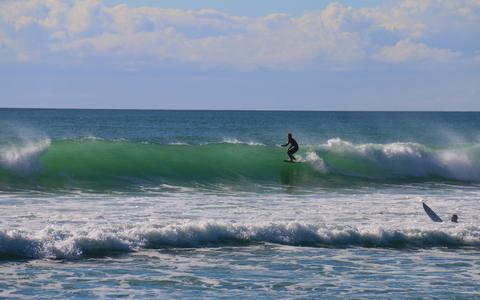
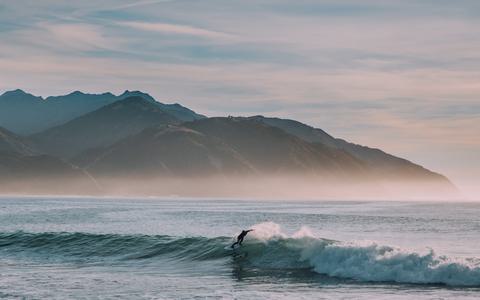
Best time to surf in New Zealand.

The best time to surf in New Zealand is May, July and December to March, when both breaks we score are in season. The waves run biggest April to May and July to October (typical faces 6 to 7 ft) and smallest June and December to January (5 ft).

The 2 New Zealand breaks we score against years of hindcast, month by month: what makes each one work, when it is in season, the water, and how to get there. Each break's page has its live forecast and the trip from your airport.

This week

  1. Raglan (Manu Bay)Mon Nov 234 ft8/10
  2. PihaMon Nov 234 ft6/10

Updated

Get a phone alert when a break in New Zealand fires.

Get the iPhone app
QR code for BarrelFare on the App StoreOn an iPhone? Scan for the app.

Best time to surf in New Zealand, month by month

How many of the 2 breaks are in season each month, and the median typical wave, share of surfable days and water temperature across all of them.

MonthIn seasonTypical waveSurfable daysWaterWear
Jan 2 of 2 5 ft 84% 21 C / 69 F spring suit
Feb 2 of 2 6 ft 83% 21 C / 70 F spring suit
Mar 2 of 2 6 ft 73% 20 C / 68 F spring suit
Apr 1 of 2 6 ft 80% 19 C / 66 F 3/2
May 2 of 2 7 ft 71% 17 C / 63 F 4/3
Jun 1 of 2 5 ft 71% 16 C / 60 F 4/3
Jul 2 of 2 6 ft 65% 14 C / 58 F 4/3 + boots
Aug 1 of 2 6 ft 71% 14 C / 57 F 4/3 + boots
Sep 0 of 2 7 ft 55% 15 C / 58 F 4/3 + boots
Oct 0 of 2 6 ft 59% 16 C / 61 F 4/3
Nov 0 of 2 5 ft 66% 18 C / 64 F 4/3
Dec 2 of 2 5 ft 65% 20 C / 67 F 3/2

Each break in New Zealand, month by month

BreakJFMAMJJASOND
Piha
Raglan (Manu Bay)

BestGoodShoulderOff

Piha

Black-sand bar peaks under Lion Rock; NZ's surf-city beach soaks up relentless Tasman SW swell.

The wave. Piha is a black-sand beach break on Auckland's west coast, with left and right peaks over sand. Lion Rock splits it in two. North Piha picks up more power, and South Piha has wedgy A-frames and a reliable left off Camel Rock at the south headland. The beach has hosted national and international surf contests.

When it works. West to southwest groundswell from the Tasman Sea is the best match, and east wind blows offshore. Autumn is a favorite, with steady swell and thinner crowds. Summer swells are smaller, and winter storms can blow out or close out the peaks.

Watch out for. Rips are the main hazard, and they are strongest in winter and on big swells. The currents around Lion Rock can shift with little warning. High tide and big swells bring dumpy shorebreak at North Piha. Kelp and submerged rocks sit near the south end takeoff, and weekends get crowded.

Who it suits. Small, clean days suit most levels, and the chest-high waves of spring are good for learning. Overhead days at North Piha and big days on the south end are for experienced surfers.

Nearby. Karekare, the next beach south, is a peaky beach break over sand with a few rocks, and it can get hollow on bigger days. White's Beach, one bay north, gives short, punchy lefts and rights that run fast on southwest swell and are best with no wind.

The wave
A punchy beach break.
Best months
Jan–Mar
Typical face
5–6 ft in season
Surfable days
80% in season
Water in season
21 C / 69 F, spring suit
Sweet spot
4 ft faces
Tide
Best on a mid-low tide
Nearest airport
AKL
Getting there
49.8 km by road from AKL, about 59 min.

Flying in with a board. Airlines we have seen into AKL: American Airlines, Jetstar, United Airlines, Air New Zealand, Qantas, Fiji Airways.

Forecast and the trip from your airport

Raglan (Manu Bay)

Long peeling left point.

The wave. Manu Bay is a long left-hand point that wraps around a rocky point over boulders, about 8 km from Raglan town. Rides run over 300 m, with hollow sections between walls. It appeared in the 1966 film The Endless Summer, and its traditional name is Waikeri.

When it works. South to southwest groundswell is the best match, and southeast wind blows offshore. It can still be good in light onshore winds. Surf comes in all year.

Watch out for. The bottom is rock and boulder, so take care on entry and exit, and most surfers jump off the rocks to paddle out. The lineup is busy, most of all on weekends when the car park fills. Locals are protective, so do not drop in.

Who it suits. Manu Bay is for intermediate and advanced surfers. Beginners do better at Ngarunui Beach, a sand-bottom beach on the town side with several surf schools.

Nearby. Indicators, the outermost of the three points, is a fast left that can run up to 600 m and barrels most at low tide. Whale Bay, between Manu and Indicators, is the mellowest of the three.

The wave
A punchy point break.
Best months
Jan–Jun
Typical face
5–7 ft in season
Surfable days
82% in season
Water in season
19 C / 67 F, 3/2
Sweet spot
7 ft faces
Tide
Best on a mid tide
Nearest airport
HLZ
Getting there
67.7 km by road from HLZ, about 59 min.

Flying in with a board. Airlines we have seen into HLZ: Air New Zealand, Jetstar.

Forecast and the trip from your airport

Surfing in New Zealand: quick answers

When is the best time to surf in New Zealand?

The best time to surf in New Zealand is May, July and December to March, when both breaks we score are in season. The waves run biggest April to May and July to October (typical faces 6 to 7 ft) and smallest June and December to January (5 ft).

When are the waves biggest in New Zealand?

The waves run biggest April to May and July to October (typical faces 6 to 7 ft) and smallest June and December to January (5 ft).

When is the off season for surf in New Zealand?

September to November: none of the 2 breaks we score is in season then.

What wetsuit do I need to surf in New Zealand?

It depends on the month. The water runs from 14 C / 57 F in August (4/3 + boots) to 21 C / 70 F in February (spring suit), the median across the breaks.

Which airport do I fly into to surf in New Zealand?

It depends on the break: each one we score has a different nearest airport (AKL, HLZ). Each break's page has the ground leg from the airport.

Season figures come from years of hindcast, not a forecast (how we score a month). All countries: the full spots index. By month instead: where to surf, January through December.